
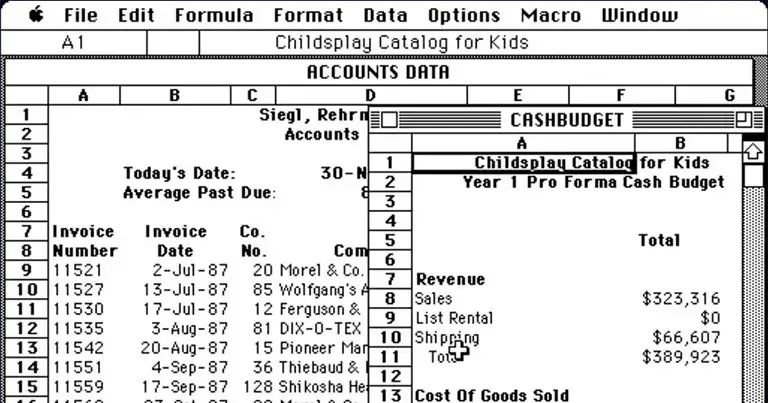
Most UK small businesses do not make a conscious decision to hold onto outdated tools. It just happens gradually - a workaround here, a manual step there, until one day you realise half your team is doing admin that software should be handling for you. If that sounds familiar, it is often a sign that your current mix of systems, spreadsheets and subscriptions is no longer supporting the way your business actually runs.
The tricky part is that "it mostly works" for a surprisingly long time. Until it does not. Below are five signs we see regularly that suggest a business has hit that ceiling and may need either better integration, a cleaner process, or a move towards custom software.
1. You are managing things across too many places
You have customer records in one system, invoices in another, project notes in a shared drive, and the really important stuff in someone's inbox. Everyone roughly knows where things live - until they do not, and something falls through the gap.
This is not a people problem. It is a structure problem. When information is scattered, the real cost is invisible: time spent hunting for things, mistakes made on stale data, and decisions made without the full picture. We often see this as the first step before businesses start exploring a more joined-up software solution.
2. Your reports require a lot of prep work
If pulling together a weekly report means exporting from multiple tools, pasting into a spreadsheet, fixing formatting and then hoping nobody moved a column - that is a signal. Reporting should be a few clicks, not a Friday afternoon project.
The underlying issue is usually that the data is not connected. Each tool knows its own slice of the business, but nothing has the whole view. If that feels familiar, our post on why custom software beats spreadsheets for UK SMEs covers the same problem from the spreadsheet side.
3. Onboarding new staff takes longer than it should
When processes live in people's heads rather than in systems, knowledge transfer becomes a bottleneck. New starters shadow someone for a week not because the work is inherently complex, but because there is no other way to learn "how we do things here."
Well-built software enforces process. The steps are in the system, not just in someone's memory. That does not always mean a full bespoke rebuild, but it usually means the current stack needs another look.
4. You are paying for overlapping tools
This one often surprises people when they stop to count. A CRM that does some project management. A project tool that handles some client comms. A separate invoicing tool that duplicates half the client data from the CRM. Each one was a sensible decision at the time.
The result is unnecessary cost, duplicated data entry, and a lot of integrations that half-work. Sometimes consolidating onto a cleaner internal platform ends up cheaper than the combined subscriptions - and considerably less frustrating. In some cases, that also creates opportunities for AI-assisted workflows because the right data is finally in one place.
5. There is a process nobody questions anymore
Every business has at least one. A weekly CSV that gets emailed around. A manual check that happens because the system "sometimes gets it wrong." A step that exists because of how things were set up in 2019 and nobody has revisited it since.
These processes are worth questioning. Usually there is a better way - it just requires someone to look at it fresh. That is often where a short audit creates the biggest return.
What to do about it
The first step is usually an honest audit of where time actually goes. Not where people think it goes, but where it actually goes. Talk to the people doing the work, not just the people overseeing it.
From there, it is worth separating "things that could be fixed with better configuration of existing tools" from "things that genuinely need something new." Not everything requires bespoke software - but when you find a core workflow that nothing off-the-shelf fits well, that is usually where a focused build pays for itself fairly quickly.
If any of this sounds familiar and you would like a second opinion on where the friction in your business is coming from, contact us. If AI is part of the conversation too, our post on getting real value from AI without the hype is a useful companion read.